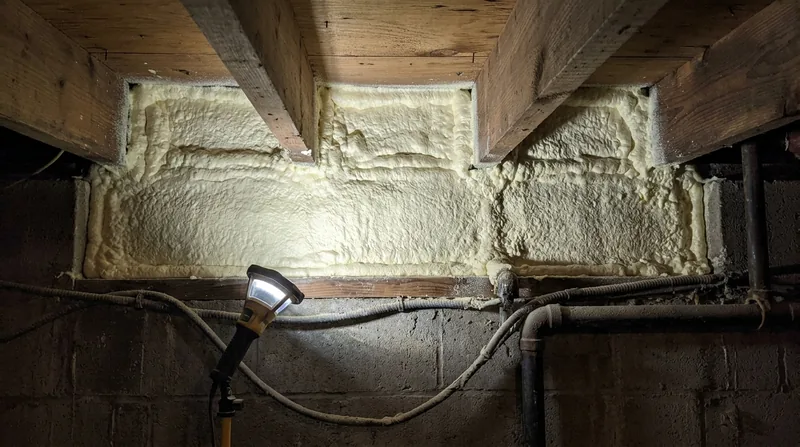




Closed cell spray foam insulation in Bloomington is built for the climate and building stock of McLean County. Older homes near downtown and around Illinois State sit over basements that stay damp after heavy rains, while mid-century ranches and newer subdivisions on the east side bring rim joists, rooms over garages, and vented attics that leak heat and pull in humid summer air. Across the farmland toward Heyworth, Downs, and Hudson, machine sheds and shops face condensation and temperature swings that open-cell foam cannot handle. Closed cell foam stands up to the humid summers and damp basements found across McLean County. We spray it in rim joists, crawl space walls, and machine sheds where condensation and temperature swings are common across the farmland. In winter, heating loss through cold rim joists and basement walls drives energy bills higher; in summer, vented attics trap humid heat that cools loads cannot match. Closed cell foam seals both problems with an air barrier and a vapor retarder in one pass, which is why it works where fiberglass and open cell fail.
Why Closed Cell Spray Foam Insulation Matters in Bloomington's Damp Basements and Cold Rim Joists
Bloomington and Normal sit on the open farmland of Central Illinois, where nearly every house sits over a basement. Older properties and farmhouses toward Heyworth and Hudson often have crawl spaces that collect moisture after storms, and rim joists around the perimeter of the foundation are rarely sealed. Winter temperatures drop below freezing for weeks at a time, pushing cold air through unsealed band joists into the basement and the rim cavity above it. In summer, humidity reverses the vapor drive, pushing moisture inward through vented attics and damp crawl spaces. Closed cell foam resists both directions of vapor drive because it carries a high vapor permeability rating and an air barrier in the same material. Fiberglass and blown-in cellulose absorb moisture and settle; open cell foam is permeable and lets humid air pass through. Closed cell stops the cycle and protects the framing from rot and the basement from mold.
- Closed cell foam carries an R-value of 6.0 to 6.5 per inch, so a 2-inch layer in a rim joist cavity delivers R-12 to R-13 in the space where heat loss is steepest in winter.
- Closed cell foam blocks vapor drive in both directions, so it protects rim joists and crawl space walls from the seasonal humidity swings that dominate McLean County.
- Closed cell foam adheres to concrete, steel, and wood, so it seals air leaks around rim joist boxes, band joists, and the rim band of older foundations without additional tape or membrane.
- Closed cell foam is rigid once cured, so it does not settle or compress over time like fiberglass batts or blown-in insulation.
These properties make closed cell foam the standard choice for rim joists, crawl space walls, and basement band joists across the Midwest, where damp basements and cold rims are the rule, not the exception.
Key info: A rim joist in Bloomington that is vented to the basement or crawl space loses more heat per square foot than the attic above it. Sealing and insulating the rim with closed cell foam stops cold air infiltration and reduces the heating load on the basement zone by 20 to 40 percent, depending on the current state of the rim cavity.
For more detail on how closed cell foam protects crawl spaces, see our crawl space spray foam insulation page.
How We Install Closed Cell Spray Foam Insulation in Bloomington Homes and Buildings
Closed cell spray foam is a two-part mixture (polyol and isocyanate) that is mixed at the spray head and applied at a controlled rate to the substrate. The foam expands and hardens in seconds, forming a solid, vapor-retarding air barrier. Installation begins with site inspection to identify the substrate condition, moisture, air leaks, and the target R-value. We then prepare the work area by clearing debris, opening access points, and setting up mechanical ventilation to manage VOC off-gassing during cure. The spray rig is positioned for line-of-sight to the cavity, and the foam is applied in passes of controlled thickness (typically 1 to 2 inches per pass) to ensure proper rise, density, and adhesion. After cure (24 to 48 hours, depending on ambient temperature and humidity), the foam is trimmed flush with the framing and any required thermal barrier or ignition barrier is installed per local code.
- We inspect the rim joist or crawl space wall for moisture, standing water, or active leaks before any foam is applied, because we will not spray over a wet or contaminated substrate.
- We set up mechanical ventilation during the spray and cure process to pull VOC off-gassing out of the work area and reduce re-entry time.
- We apply closed cell foam in controlled passes to achieve the target R-value and thickness specified in the estimate, with no guesswork or over-spray.
- We trim the cured foam flush with the framing and install any thermal or ignition barrier required by the local building code at your address.
- We provide a written estimate that names the R-value, thickness, and board-foot total before work begins, so you know exactly what you are paying for.
This step-by-step approach ensures the foam is installed correctly the first time and that the air barrier and vapor control are continuous and durable.
Example: A basement rim joist in Hudson or Heyworth that measures 16 inches tall and runs 120 linear feet around the perimeter requires about 160 board feet of closed cell foam at 1.5 inches thick to deliver R-9 protection. Spray time is 2 to 3 hours, cure is 24 to 48 hours, and the total cost depends on substrate prep, access, and the current state of the cavity. We provide a free estimate with all these details spelled out.
See our rim joist and band joist foam page for more detail on this common application.
Closed Cell Spray Foam Installation Methods and Best Use Cases
| Application | Description | Why Closed Cell Works |
|---|---|---|
| Rim Joist and Band Joist | Spray closed cell foam 1.5 to 2 inches thick on the interior face of the rim cavity, from the top of the foundation wall to the band board above. | Blocks air infiltration and vapor drive, seals the thermal break where the rim meets the foundation, and protects the sill plate and band board from seasonal moisture. |
| Crawl Space Wall | Spray closed cell foam on the interior face of the crawl space wall from rim to grade, creating a continuous air and vapor barrier. | Stops humid air and ground moisture from entering the crawl space, controls condensation on pipes and joists, and reduces heating load in winter. |
| Machine Shed or Metal Building | Spray closed cell foam on the interior of the metal walls and roof deck to create a thermal and moisture barrier. | Metal conducts heat and cold; closed cell foam stops condensation on the inside face and protects equipment and stored goods from temperature swings and rust. |
| Basement Wall or Basement Ceiling | Spray closed cell foam on the interior face of a basement wall or on the band joist and rim above, depending on the moisture source and the desired R-value. | Resists vapor drive from the ground and from seasonal humidity, protects the basement from mold and moisture damage, and improves comfort in the basement living space. |
Closed Cell Spray Foam Insulation Cost in Bloomington: What to Expect
Closed cell spray foam pricing in Bloomington starts at $1.20 per board foot and moves up based on substrate prep, access, the complexity of the cavity, and the target R-value. A simple rim joist with clear access and a dry substrate will be at the lower end of the range; a crawl space with standing water, debris, or tight access will require more prep work and will cost more. The size of the job also matters: a small rim joist application of 100 to 150 board feet will have a higher per-board-foot cost than a 500-board-foot crawl space job, because mobilization and setup are fixed. Travel within Bloomington and surrounding areas is included; no separate mileage fee applies. We provide a free written estimate that names the R-value, thickness, board-foot total, and the final price before work begins, so there are no surprises.
Factors that affect the cost of closed cell spray foam insulation include:
- Substrate condition: a dry, clean rim joist cavity costs less to prepare and spray than a crawl space with standing water or debris.
- Access and line-of-sight: a rim joist with clear access from the basement costs less than a tight crawl space or a cavity behind existing insulation that must be removed first.
- Target R-value and thickness: R-9 at 1.5 inches costs less than R-12 at 2 inches, but the difference is small because the material cost is the main driver.
- Job size: a 100-board-foot job has a higher per-board-foot cost than a 500-board-foot job, because setup and mobilization are spread across fewer units.
- Existing insulation removal: if fiberglass or blown-in insulation must be removed before foam is sprayed, that adds time and cost to the project.
The best way to get an accurate price for your rim joist, crawl space, or basement application is to request a free estimate from us at (309) 487-2702 or through our contact page. We will visit your home or building, assess the substrate and cavity, and provide a written quote with R-value and thickness spelled out. Compare quotes from at least two other contractors to ensure you are getting fair market value. See our full pricing page for more detail on cost factors and typical ranges.
What to Look for When Hiring a Closed Cell Spray Foam Insulation Contractor Near Bloomington
Spray foam insulation is a technical trade with real risks if it is not done correctly. A bad installation can trap moisture in the cavity, create a strong chemical smell that lingers for weeks, or leave gaps in the air barrier that defeat the purpose of the foam. When you are comparing contractors in Bloomington, Normal, Downs, Hudson, or anywhere in McLean County, verify their credentials, understand their process, and ask for references from recent jobs.
Here is what to check:
- Ask the contractor for proof of current insurance (general liability and workers compensation) and request a copy of the certificate of insurance before work begins.
- Get a written estimate that names the R-value, thickness in inches, total board feet, and the final price, not just a per-board-foot rate with no detail.
- Ask about the spray foam system being used (manufacturer, ratio, drum temperature) and verify that the contractor has been trained by the manufacturer or holds current certification from the foam supplier.
- Confirm that the contractor will set up mechanical ventilation during spray and cure, will not promise immediate re-entry, and will provide a realistic re-entry window of 24 to 48 hours depending on temperature and humidity.
- Ask whether the contractor pulls permits for your address and defers to the local building department on thermal barrier and ignition barrier requirements, because code varies by city and the building official has the final say.
- Request references from at least two jobs completed in the last 12 months in Bloomington or nearby areas, and call those homeowners to ask about the smell, the cure time, and whether the contractor was reachable after the job was done.
- Verify that the contractor has a local address and local phone number, not a cell phone and a PO box, and that they are reachable if issues arise after the work is complete.
Avoid contractors who give you an estimate with no R-value or thickness, promise immediate re-entry, offer a price far below the market rate with no inspection, or cannot provide proof of insurance or references. These are the markers of a rig-and-run operation that will disappear after the smell becomes a problem. We have been in business since 2014, we are fully insured, and we provide written estimates with R-value and thickness before work begins. Contact us for a free estimate at (309) 487-2702.
Closed Cell Spray Foam Insulation in Bloomington: Pricing Guide
| Service | Price | Details |
|---|---|---|
| Rim Joist or Band Joist Insulation | Starting at $1.20/board ft | 1.5 to 2 inches of closed cell foam, R-9 to R-13, substrate prep included, dry cavity required |
| Crawl Space Wall Insulation | Starting at $1.20/board ft | 1.5 to 2 inches per pass, vapor retarder included, prep cost increases if moisture or debris present |
| Machine Shed or Metal Building | Starting at $1.20/board ft | Walls and roof deck, condensation control, larger jobs typically qualify for volume pricing below base rate |
| Basement Wall or Ceiling | Starting at $1.20/board ft | Interior face application, 1.5 to 2 inches, cost varies by moisture condition and access to the cavity |
| Travel and Mobilization | Included | No separate charge within Bloomington and surrounding service areas, rig setup and site prep included |
| Free Written Estimate | No charge | Response within 24 hours, R-value and thickness specified, no obligation to book, call (309) 487-2702 |
Indicative pricing, the exact cost depends on square footage, finish, and site access. Free personalized estimate within 24h at (309) 487-2702.


