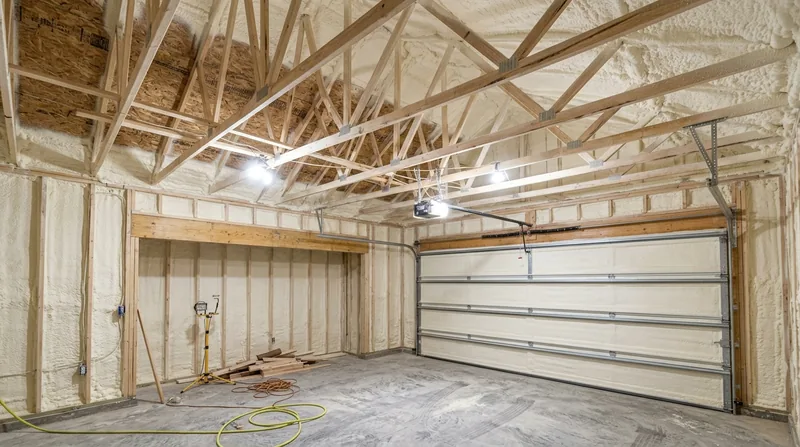




Garage spray foam insulation in Bloomington transforms attached garages from thermal weak points into conditioned spaces that hold temperature year-round. Bloomington and Normal garages sit between heated homes and the open Midwest climate, absorbing winter cold that bleeds into living spaces above and beside them, then trapping humid summer heat that makes rooms overhead unbearable. The newer east-side subdivisions around Normal carry rooms built over garages, and those spaces swing 20 to 30 degrees between seasons without insulation in the walls and ceiling. We spray closed-cell or open-cell foam into garage walls, band joists, and ceilings to seal air leaks, even out temperature swings, and stop condensation that corrodes tools and vehicles. The result is a garage that stays dry in spring thaw, cool in July, and warm enough in January that you can work without freezing.
Why Garage Insulation Matters in Bloomington's Cold Winters and Hot Summers
Attached garages in McLean County are thermal leaks by design. A typical two-car garage attached to a Bloomington ranch or newer subdivision home shares walls and a ceiling with the conditioned house, but those separating surfaces are often uninsulated or filled with fiberglass batts that have settled and lost contact with the framing. In winter, the garage pulls heat from the home through every gap and thin spot. In summer, the garage becomes a heat sink that radiates into upstairs bedrooms and into the basement stairwell. Rooms directly above the garage are the worst: uninsulated garage ceilings let cold air rise in winter and hot air radiate through in summer, making those bedrooms 10 to 15 degrees harder to condition than the rest of the house.
- We seal the rim joist where the garage meets the house foundation, stopping air leakage that pulls conditioned air out of the home.
- We foam garage walls facing the outside to block wind and temperature swings before they reach the house side.
- We insulate the garage ceiling with closed-cell or open-cell foam to prevent heat loss upward in winter and radiant heat gain into rooms above in summer.
- We air seal the band joist and all rim cavities to eliminate the convective loop that draws cold air up and warm air out.
Sealing and insulating a garage is one of the highest-return energy improvements in a cold Midwest home because it stops the most direct path of heat exchange between conditioned and unconditioned space.
Key info: A Bloomington homeowner with a room over the garage typically sees that room drop 15 to 20 degrees in winter and rise to 85 degrees in summer. Foam insulation in the garage ceiling, combined with air sealing at the rim joist, brings that room into the 68 to 72 degree range year-round. Check your local building department for any attic ventilation or thermal barrier requirements that apply to your specific address, as these vary by city and year of construction.
How We Insulate Garages in Bloomington: Step-by-Step Process
Garage foam insulation starts with a site inspection to measure the space, identify air leaks, and determine whether the existing structure can support spray foam or whether we need to remove old insulation first. We assess the garage ceiling framing, the rim joist at the band, exterior walls, and any interior walls that separate the garage from living space. Once we confirm the substrate is dry and sound, we set up mechanical ventilation, spray the foam in controlled passes to the specified thickness and R-value, and allow the proper cure time before re-entry. The whole process typically takes one day for a standard two-car garage, plus 24 to 48 hours for the foam to fully cure before the space is occupied.
- We inspect the garage structure, measure ceiling height and wall dimensions, and identify any moisture or damage that must be addressed first.
- We remove any existing fiberglass batts or settling insulation that would interfere with foam application or trap moisture.
- We set up mechanical ventilation and establish a perimeter to control fumes during the spray process.
- We spray closed-cell or open-cell foam in even passes, building thickness in layers to meet your R-value target without overspray or pooling.
- We allow 24 to 48 hours cure time and verify the foam has set before you re-enter or park vehicles in the space.
This controlled approach prevents the common mistakes that plague garage insulation: spraying over a wet substrate, rushing the cure, or applying foam too thick in a single pass, which causes internal voids and weak spots.
Example: A homeowner in Hudson with a 400-square-foot garage ceiling and an uninsulated rim joist calls in January because the garage is 28 degrees and the utility room above is impossible to heat. We remove the old settling batts, spray 2 inches of closed-cell foam in the ceiling (R-13 to R-15), and seal the rim joist with open-cell foam. Total time on site is 6 hours. By February, the garage holds 45 degrees on the coldest nights, the utility room stays above 60, and the homeowner stops feeling cold air coming through the kitchen wall that backs the garage.
Foam Types and Methods for Garage Insulation
| Approach | Description | Best for |
|---|---|---|
| Closed-Cell Spray Foam | Dense foam, R-6 to R-7 per inch, vapor barrier, moisture resistant, requires mechanical ventilation during cure. | Garage ceilings and exterior walls where moisture control and high R-value per inch are critical; band joists and rim cavities in basements below garages. |
| Open-Cell Spray Foam | Lighter foam, R-3.5 per inch, air barrier only, breathable, lower cost, faster cure, requires mechanical ventilation during spray. | Garage walls and ceilings in dry climates or where cost is the primary driver; interior rim joists where vapor permeability is acceptable. |
| Foam + Existing Cavity | Spray foam top-up over old settling fiberglass or into partial cavities to bring R-value up without full removal. | Garages where the existing insulation is sound but compressed, or where full removal would be cost-prohibitive. |
| Removal and Replacement | Complete removal of old batts, blown-in, or failed foam, followed by new closed-cell or open-cell spray application. | Garages with water damage, mold, rodent contamination, or insulation that has shifted or lost effectiveness. |
Closed-cell foam is the most common choice for garage insulation in Bloomington because it delivers high R-value in a thin layer, stops air and moisture infiltration, and holds up to the temperature swings and humidity that garages experience. Open-cell foam works well for interior garage walls and ceilings where cost matters and the space is kept dry. We help you choose based on your garage layout, your budget, and whether the space is conditioned or vented.
Garage Spray Foam Insulation Cost in Bloomington: What to Expect
Garage insulation pricing in the Bloomington area starts at $1,200 for a basic two-car garage ceiling and rim joist seal, and scales with the size of the space, the foam type you choose, and how much existing insulation needs to be removed. A 400-square-foot garage ceiling at 2 inches of closed-cell foam runs roughly $1,200 to $1,800. If you add exterior wall insulation or a room above the garage, the cost rises. Removing old insulation adds time and disposal, which increases the total. The best way to know your actual cost is to request a free estimate, where we measure on site and give you a written quote with R-value and thickness specs.
Several factors shift the price within that range. A garage with a complex framing layout, existing moisture damage, or tight access costs more to spray than a simple rectangular space. If you choose closed-cell foam instead of open-cell, the cost per board foot is higher but you need fewer inches to hit your R-value target. Removal of old insulation adds 4 to 8 hours of labor. Travel within Bloomington and surrounding areas is included in our estimate, so you only pay for the work itself.
We recommend getting 2 or 3 estimates from local contractors so you can compare not just price but approach: a solid estimate includes the foam type, the thickness in inches, the R-value you will achieve, and the timeline. Avoid any quote that skips these details or promises a price far below market, because that usually means corners will be cut during the spray or cure.
See our full pricing overview for more detail on how we structure costs and what drives the range. Call us at (309) 487-2702 for a no-obligation estimate within 24 hours.
What to Look for When Hiring a Spray Foam Insulation Contractor Near Bloomington
Finding a reliable spray foam contractor in Bloomington means checking credentials, understanding the scope of work, and verifying that the contractor knows your local building code. Start by asking whether the contractor is fully insured and request a certificate of insurance. Check that they have experience with garage insulation specifically and can explain the difference between closed-cell and open-cell foam. Ask for references from recent garage jobs in Bloomington or Normal, and call those homeowners to ask whether the work was clean, the cure time was respected, and the contractor was reachable if questions came up afterward.
Permitting rules for garage insulation in Bloomington vary by address and year of construction. Some older homes fall under specific energy code requirements, and some newer homes in subdivisions may have HOA rules about exterior work. Ask your contractor to help you understand what applies at your address and whether a permit is required. Your local building department has the final say, so verify requirements with them directly before work begins.
Get written estimates from at least two contractors, and compare them side by side. A good estimate includes the foam type, thickness in inches, the R-value you will achieve, the timeline, and any prep work (like removal of old insulation). Avoid any contractor who gives you a price without visiting the site, who promises immediate re-entry before 24 hours, or who cannot explain how they will manage ventilation during the spray. These are the hallmarks of a rig-and-run operation that leaves homeowners with lingering odor, weak insulation, and no one to call when problems arise.
When you are ready to move forward, contact us for a free estimate. We measure on site, explain your options, and give you a clear written price with all the details you need to make a decision.
Garage Spray Foam Insulation in Bloomington: Pricing Guide
| Service | Price | Details |
|---|---|---|
| Basic garage ceiling insulation | Starting at $1,200 | Two-car garage ceiling, 2 inches closed-cell foam, R-13 to R-15, includes rim joist sealing |
| Garage ceiling plus exterior walls | Starting at $1,800 | Ceiling plus one or two exterior walls, closed-cell or open-cell, depends on wall area and existing insulation |
| Room above garage (full insulation) | Starting at $2,400 | Garage ceiling, exterior walls, and band joist, closed-cell foam, R-value optimized for conditioned space above |
| Removal and replacement | On estimate | Existing insulation removal, disposal, and new foam application; final cost depends on what is being removed and space size |
| Travel | Included | No mileage fee or travel surcharge within Bloomington and surrounding service areas |
| Free estimate | No charge | On-site measurement, written quote with R-value and thickness specs, response within 24 hours at (309) 487-2702 |
Indicative pricing, the exact cost depends on square footage, finish, and site access. Free personalized estimate within 24h at (309) 487-2702.


