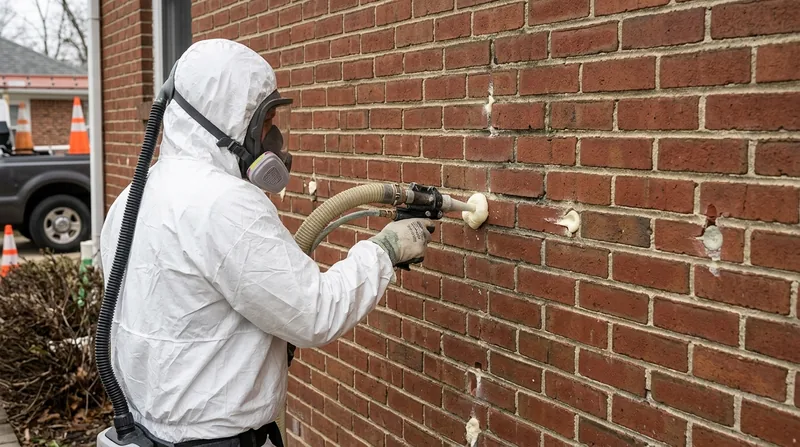




Bloomington and Normal homes built before 1980 often have wall cavities that were never insulated or contain settled, deteriorated insulation that no longer performs. Wall and injection foam insulation fills these closed cavities without opening walls, stopping cold air infiltration in winter and reducing humidity-driven cooling loads in summer across Central Illinois. Our crew injects closed-cell or open-cell foam directly into existing wall voids, sealing air leaks and raising R-value in place. This retrofit approach works on the ranch homes scattered across McLean County, the older downtown Bloomington stock near the courthouse, and the mid-century neighborhoods around Illinois State. No demolition, no weeks of wall removal, no exposed framing. We handle the injection, manage the cure, and leave your walls intact.
Why Wall and Injection Foam Matters in Bloomington's Older Homes
Bloomington's pre-1980 housing stock sits on open farmland with winters that drop well below freezing and humid summers that push moisture into walls from the outside. Original wall cavities in these homes were often left empty or filled with fiberglass batts that have compressed over decades, leaving 30 to 50 percent of the cavity as dead air space. This air moves freely, carrying cold from the exterior sheathing inward during winter and allowing humid outside air to enter during summer. The result is steady heating loss, higher cooling demand, and condensation risk inside the wall. Injection foam seals these cavities completely, stopping air movement and raising the effective R-value of the wall assembly without disturbing drywall, siding, or interior finishes.
- We drill small access holes (typically 1 to 1.5 inches) through siding or interior walls, spaced 16 inches apart along the stud cavity.
- Foam is injected under controlled pressure, filling the entire cavity from bottom to top and around any obstructions.
- The foam expands slightly, sealing air gaps and adhering to studs, sheathing, and existing insulation.
- Access holes are plugged with foam and patched, leaving minimal visible trace.
- The wall cavity becomes a sealed, continuous insulation barrier that stops infiltration and reduces vapor transmission.
This approach is the only retrofit option for homes whose walls cannot be opened without structural or cosmetic damage, and it is the fastest way to add R-value to existing construction.
Real example: A 1970s ranch home on the east side of Bloomington with original fiberglass batts in the exterior walls reported heating bills 20 to 25 percent higher than comparable homes on the same street. After injection foam retrofit of the north and west walls (the sides facing winter wind), the homeowner saw measurable reduction in drafts and a return to typical heating costs for the neighborhood. The walls stayed intact, no drywall repair was needed, and the work was complete in one day.
For permit and code requirements specific to your address in Bloomington, contact the City of Bloomington Building Department at (309) 434-2350. Thermal barrier and ignition barrier rules vary by year of construction and local code adoption, and the building official will clarify what applies to your retrofit.
How We Inject Foam Into Walls: Step-by-Step Process
Injection foam retrofit begins with a site visit to identify the cavity layout, locate any obstructions (pipes, wires, blocking), and determine whether the cavity is accessible from the interior or exterior. We take photographs and measurements to plan drilling locations and calculate the foam volume needed. Most Bloomington homes have standard 2x4 or 2x6 stud cavities with predictable depths, so our estimate process is straightforward and fast. We then schedule the injection work at your convenience, typically completing it in a single visit.
- We protect floors and furnishings with drop cloths and plastic sheeting before drilling any holes.
- Holes are drilled at the bottom of each cavity, spaced to ensure complete fill without voids or bridging.
- Foam is mixed on site at the correct ratio and drum temperature, then injected through hoses into the cavity.
- We monitor injection pressure and cavity fill by weight or visual inspection, stopping when the cavity is full.
- Holes are plugged with foam backer rod or spray foam, then patched with caulk or drywall compound to match the wall.
- The home is ventilated for 24 to 48 hours during and after cure; we provide re-entry guidelines and confirm safe air quality before you return to normal use.
The entire process is clean, contained, and non-invasive. You remain in your home during the work, and disruption is minimal.
Local example: A homeowner in Normal near Illinois State University wanted to improve comfort in a bedroom over an unheated garage without opening walls. Injection foam was applied to the exterior wall cavity and the rim joist above the garage, raising the wall R-value from approximately R-8 (compressed batts) to R-20 (closed-cell foam). The room no longer felt drafty, and winter heating to that zone was noticeably easier. Total time on site was 3 hours, and the wall finish was untouched.
For more information on how injection foam works alongside other air sealing methods, see our air sealing page.
Injection Foam Methods and Materials
| Method | Description | Best for |
|---|---|---|
| Closed-cell injection foam | Rigid, high-density foam (1.5 to 2 lbs/cu ft) with R-6 to R-7 per inch. Low moisture vapor permeability. Adds structural rigidity to the cavity. | Walls prone to moisture, rim joists, band joists, and cavities where vapor control is critical in Central Illinois' humid summers. |
| Open-cell injection foam | Semi-rigid, lower-density foam (0.5 to 0.7 lbs/cu ft) with R-3.5 to R-4 per inch. Vapor-permeable, allowing walls to dry. Softer and easier to trim. | Interior walls where vapor permeability is desired, sound dampening, and budget-conscious retrofits where moisture risk is low. |
| Partial-fill (top-up) injection | Foam injected only into the upper portion of a cavity to supplement existing insulation without full replacement. Reduces material cost and cure time. | Cavities with sound insulation still in place but with settled voids, or where budget limits full retrofit to one section of the home. |
| Full-cavity injection | Entire wall cavity filled from bottom to top. Requires removal of existing insulation if it blocks flow or contains asbestos. Highest final R-value and air seal quality. | Complete retrofits, homes with deteriorated or missing insulation, and exterior walls where maximum thermal performance is the goal. |
Our crew is equipped to handle both closed-cell and open-cell foam injection, and we specify the material based on your wall orientation, local moisture risk, and energy goals. Closed-cell foam is the standard for exterior walls in Bloomington due to the seasonal moisture reversal that occurs here; open-cell is a cost-effective option for interior walls or dry climates, but it is less common in Central Illinois retrofit work.
Wall and Injection Foam Insulation Cost in Bloomington: What to Expect
Injection foam insulation typically costs between $2 and $4 per square foot of wall area, depending on cavity depth, foam type, and access complexity. A 1,000-square-foot exterior wall retrofit with closed-cell foam runs roughly $2,000 to $4,000 before any patching or finish work. Open-cell injection is 15 to 25 percent less expensive per board foot, so a partial-fill top-up with open-cell foam in a smaller area (e.g., one bedroom wall) may cost $500 to $1,200. The final price depends on several concrete factors.
- Cavity depth and width determine the volume of foam needed; a 2x6 cavity holds roughly 50 percent more foam than a 2x4 cavity.
- Foam type (closed-cell vs. open-cell) affects material cost; closed-cell is denser and more expensive but offers higher R-value per inch.
- Access difficulty matters; drilling from the exterior requires scaffolding or lift access on upper stories, while interior access from basement or attic is faster and cheaper.
- Existing insulation removal adds cost if the cavity must be cleared before injection; asbestos-containing insulation requires licensed remediation and must be left in place.
- Patching and finish work (caulking holes, drywall repair, paint or siding touch-up) are separate from the foam cost and vary by wall finish.
We always provide a written estimate that specifies the foam type, cavity dimensions, board-foot volume, R-value, and thickness, so you know exactly what you are paying for. We recommend getting 2 to 3 estimates from local contractors to compare approach and pricing; our estimate is free and carries no obligation. Call us at (309) 487-2702 or visit our pricing page for more detail on what moves the cost up or down.
Wall and Injection Foam Insulation Near Me: What Bloomington Homeowners Should Know When Hiring
Choosing a spray foam contractor for injection work requires the same due diligence you would apply to any home improvement. The trade has both local independents and out-of-state rig-and-run crews, and the difference shows up in follow-up service, warranty clarity, and how well the job is documented. Before you hire, verify that your contractor is fully insured and can provide a certificate of insurance. Ask whether they carry a workmanship warranty (typically 1 to 3 years on the installation) and get that commitment in writing. Request references from recent jobs in Bloomington or Normal, and call at least two to ask about cure time, odor management, and whether the contractor was reachable if questions came up after the work.
- Get a written estimate that includes R-value, foam thickness, board-foot volume, and material type (closed-cell or open-cell).
- Ask about ventilation during cure and the re-entry window; honest contractors specify 24 to 48 hours of mechanical ventilation and a clear re-entry timeline.
- Check whether your city or HOA requires a permit for interior insulation work; most do not, but some older Bloomington neighborhoods have architectural guidelines that touch exterior work.
- Verify that the contractor is responsive to questions and provides clear documentation of the work (photos, measurements, material specifications).
- Avoid any estimate that omits R-value, thickness, or a breakdown of what is included; vague pricing is a red flag.
If you have questions about what permits or approvals apply at your specific address in Bloomington, the City of Bloomington Building Department can clarify. We help homeowners navigate local requirements and work with your building official if needed. Contact us at (309) 487-2702 for a free, no-obligation estimate, and we will walk you through the process from start to finish.
Wall & Injection Foam Insulation in Bloomington: Pricing Guide
| Service | Price | Details |
|---|---|---|
| Injection foam, closed-cell, exterior walls | Starting at $2.50/sq ft | Full-cavity closed-cell injection, R-20 to R-24 per wall, includes drilling, foam, and basic hole patching |
| Injection foam, open-cell, interior or non-critical walls | Starting at $1.75/sq ft | Full-cavity open-cell injection, R-12 to R-16 per wall, lower cost option for sound dampening and dry interior applications |
| Partial-fill (top-up) injection over existing insulation | Starting at $1.50/sq ft | Foam injected into settled voids above existing insulation, reduces material volume and cost, ideal for budget-conscious retrofits |
| Insulation removal and full-cavity retrofit | On estimate | Removal of deteriorated or asbestos-containing insulation, cavity prep, and full injection requires site inspection to determine scope and feasibility |
| Travel and setup | Included | No separate charge for travel within Bloomington and surrounding McLean County service areas, or mileage fees |
| Free written estimate with R-value and thickness specs | Free | Response within 24 hours at (309) 487-2702, no obligation to book, includes material type and cavity dimensions |
Indicative pricing, the exact cost depends on square footage, finish, and site access. Free personalized estimate within 24h at (309) 487-2702.


