Air Sealing vs. Spray Foam: What's the Real Difference?
When homeowners in Bloomington start researching attic insulation upgrades, they often encounter two competing recommendations: air sealing and spray foam installation. Understanding the difference between these approaches is crucial to making an informed decision for your home.
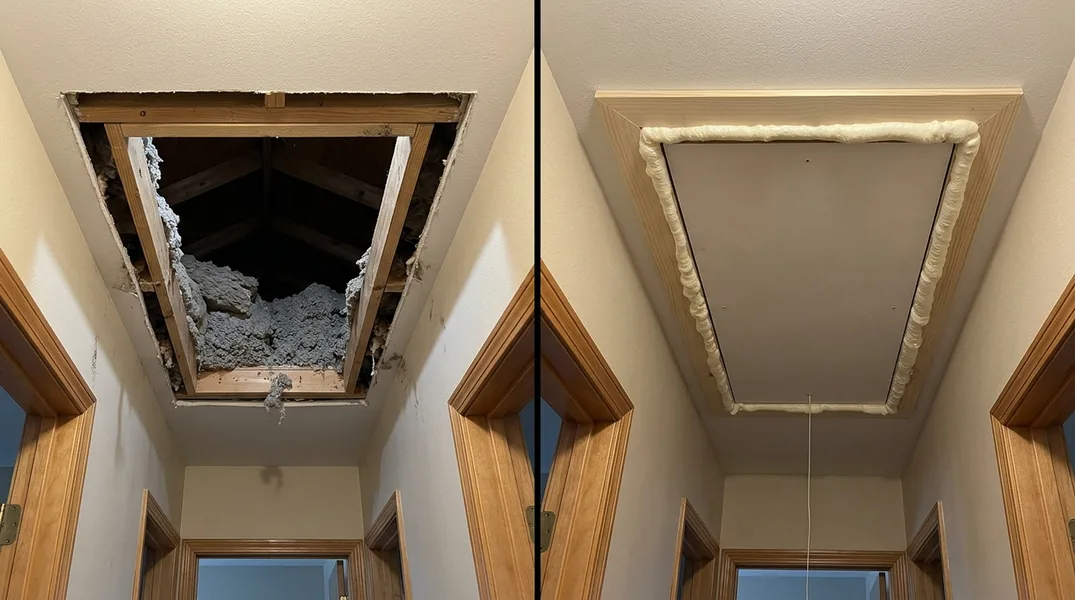
Air sealing is the process of identifying and closing gaps, cracks, and penetrations in your attic and walls using caulk, weatherstripping, or foam sealant. It stops air leaks that allow conditioned air to escape and unconditioned air to enter. Spray foam insulation, by contrast, is a chemical product that expands when applied, creating both an insulating barrier and an air seal simultaneously. The key distinction is that air sealing addresses air movement, while Attic Spray Foam Insulation provides both thermal resistance and air sealing in one application. Many energy audits recommend doing both, but the priority depends on your home's current condition and your budget.
Understanding Spray Foam Insulation R Value Per Inch and Thickness Requirements
One of the most frequently asked questions we receive is about the spray foam insulation r value per inch and how thick spray foam should be for optimal performance. The answer varies depending on which type of foam you choose. Closed Cell Spray Foam Insulation typically delivers 6 to 7 R-value per inch, making it highly efficient in tight spaces. Open Cell Spray Foam Insulation, on the other hand, provides approximately 3.5 to 3.6 R-value per inch, but costs significantly less and is often preferred for interior applications where vapor permeability matters.
The question of how thick should spray foam be depends on your local climate and building code requirements. In Illinois, attic insulation typically needs to reach R-38 to R-49 for optimal energy efficiency. With closed cell foam, you'd need about 6 to 7 inches to meet R-38. With open cell foam, you'd need roughly 11 inches. Most contractors recommend closed cell for attics due to its superior performance and moisture resistance, though your specific needs may differ based on your roof design and ventilation setup.
R Value Requirements by State and Illinois Standards
Illinois doesn't have unusually stringent insulation requirements compared to other states, but understanding the baseline is important for your project planning. The International Energy Conservation Code (IECC), which Illinois largely follows, recommends R-38 to R-49 for attic insulation depending on your climate zone. Bloomington falls in a zone where R-38 is the minimum threshold, though many energy-conscious homeowners aim for R-49 to maximize long-term savings and comfort.
When considering r value requirements by state more broadly, you'll notice that colder climates like Minnesota and Wisconsin require R-49 to R-60, while warmer states like Florida only require R-19 to R-30. Illinois sits in the middle, which means you have flexibility in your approach. Some homeowners choose to exceed the minimum code requirement because the additional cost of going from R-38 to R-49 is relatively modest when using spray foam, and the payback period through energy savings is typically 5 to 7 years. This is especially true if you can take advantage of available rebates and tax incentives.
Insulation Tax Credit and Rebates Available for Bloomington Homeowners
One of the most overlooked aspects of attic insulation projects is the potential for financial incentives. The federal government offers an insulation tax credit for homeowners who improve their home's energy efficiency, and Illinois also has state-level programs. For 2024 and beyond, the federal Inflation Reduction Act allows homeowners to claim up to 30% of the cost of qualifying insulation improvements (up to $3,200 per year) as a tax credit. This is not a deduction; it's a direct credit that reduces your tax liability dollar for dollar.
Beyond the federal insulation tax credit, you should investigate insulation rebates offered by your local utility company. Ameren Illinois, which serves much of central Illinois, frequently offers rebates for attic insulation upgrades. These rebates can range from $200 to $500 depending on the scope of your project and the type of insulation you choose. Some utility companies even offer instant rebates at the point of sale, which can be applied directly to your invoice. When you get a free estimate from Bloomington Spray Foam Insulation, our team can help you identify which incentives you qualify for and how to properly document your project for tax purposes.
Attic Spray Foam Insulation Cost in Bloomington: What to Budget
Understanding the investment required for spray foam insulation is essential for homeowners evaluating whether to proceed with a full foam job or opt for air sealing alone. The pricing for spray foam varies based on several factors: the size of your attic, the type of foam selected, current insulation conditions, and accessibility. On average, closed cell spray foam costs between $1.50 and $2.50 per board foot (a board foot is 1 foot by 1 foot by 1 inch thick), while open cell foam typically ranges from $0.60 to $1.00 per board foot. For a typical 1,500 square foot attic requiring 6 inches of closed cell foam, you're looking at a project cost of $4,500 to $7,500 before any rebates or tax credits.
Air sealing alone is far less expensive, often ranging from $500 to $2,000 depending on how many penetrations and gaps need attention. However, air sealing without additional insulation won't significantly improve your R-value. The most cost-effective approach for many homeowners is a hybrid strategy: professional air sealing combined with a moderate thickness of spray foam (4 to 5 inches of closed cell) rather than attempting a full R-49 foam job. This typically costs $2,500 to $4,000 and delivers 80% of the performance improvement at 60% of the cost. When you factor in the federal tax credit and potential utility rebates, your net investment can be reduced by 30% to 40%.
When to Choose a Full Foam Job vs. Air Sealing Near Me
The decision between a full spray foam installation and simple air sealing depends on your home's current condition, your budget, and your long-term plans. If your attic has existing insulation that's in good condition but has air leaks (common around ductwork, electrical penetrations, and the attic hatch), air sealing alone may be sufficient and cost-effective. However, if your existing insulation is compressed, wet, or missing entirely, a full foam job makes more sense because you're addressing both the insulation deficit and air leakage simultaneously.
Homeowners in Bloomington planning to stay in their home for more than 7 years should strongly consider a full foam installation. The energy savings compound over time, and spray foam doesn't settle, degrade, or lose effectiveness the way traditional fiberglass batts do. Additionally, if you're concerned about moisture, pests, or air quality, spray foam is superior because it creates a continuous barrier that prevents rodent entry and controls humidity. For those with a shorter time horizon or tighter budgets, professional air sealing combined with blown-in cellulose or fiberglass can still yield 15% to 25% energy savings at a fraction of the cost. The best approach is to schedule a professional energy audit, which will identify your home's specific weaknesses and help prioritize investments.
Next Steps: Getting Your Free Estimate
Making the right choice between air sealing and spray foam requires understanding your home's unique characteristics and your financial situation. At Bloomington Spray Foam Insulation, we help homeowners navigate this decision by providing honest, detailed assessments without pressure. We'll evaluate your attic, discuss your energy goals, explain the long-term benefits of each option, and help you understand how tax credits and rebates apply to your situation.
Ready to learn whether your Bloomington home needs air sealing, spray foam, or both? Contact us today at (309) 487-2702 or request a free estimate online. We serve Bloomington, Normal, Downs, Hudson, and the surrounding areas. Our team will walk you through every option, answer your questions about R-values and thickness, and show you exactly how much you can save with available incentives. Your attic transformation starts with a single conversation.
Looking for a professional spray foam insulation contractor in Bloomington? Bloomington Spray Foam Insulation responds fast for all your spray foam insulation needs.
Get a Free Quote