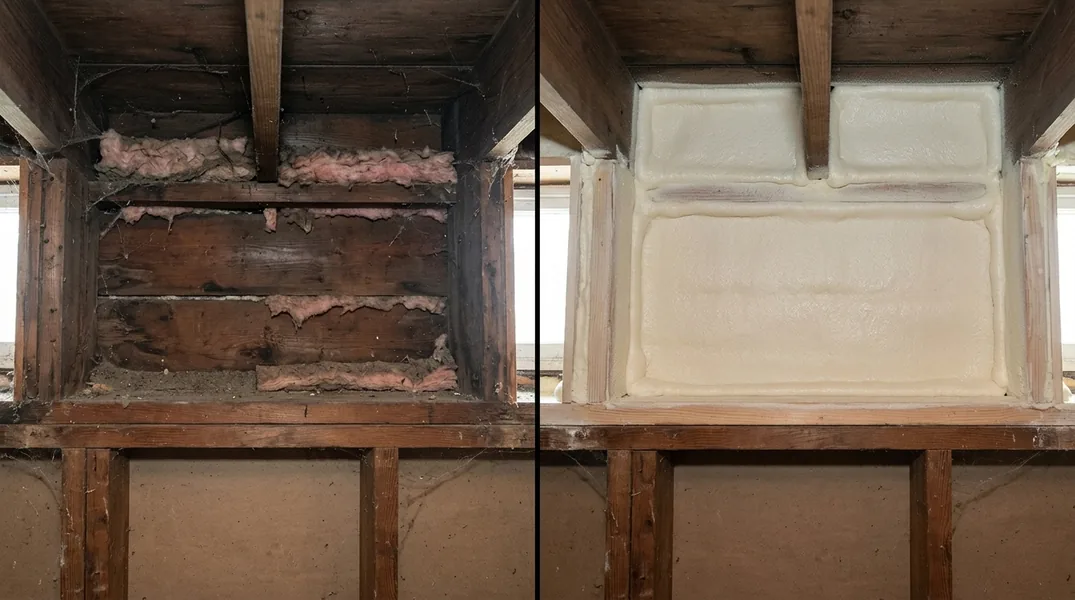
Understanding Rim Joists: The Hidden Cold Spot in Your Home
When winter arrives in Bloomington, homeowners often focus on attic insulation and weatherstripping doors and windows. However, one of the most overlooked culprits behind rising heating bills and uncomfortable cold spots is the rim joist, also called the band board. This structural component sits at the top of your foundation walls, wrapping around the perimeter of your home where the first floor meets the basement or crawl space.
The rim joist is particularly vulnerable to heat loss because it typically receives minimal insulation during construction. Many older homes in McLean County have either no insulation in this area or only fiberglass batts that have settled, compressed, or developed gaps over decades. Cold air seeps through these gaps, creating drafty floors on the first level and forcing your heating system to work harder than it should. If you notice that your first-floor rooms feel noticeably colder than upstairs, or if you feel a draft near the baseboards, the rim joist is likely the problem.
Why Drafty Floors Get Worse in McLean County Winters
McLean County experiences long, harsh winters with temperatures that regularly dip below freezing for extended periods. When the outdoor temperature drops significantly, the temperature differential between your heated indoor space and the cold rim joist area becomes extreme. This temperature gradient accelerates heat loss through any gaps, cracks, or poorly insulated sections of the rim joist. The result is that your heating system must run more frequently and longer to maintain a comfortable temperature, which translates directly into higher energy bills and reduced comfort.
Drafty floors also create uneven heating throughout your home. The first floor may feel cold and uncomfortable while upper floors remain warm, forcing you to adjust your thermostat higher than necessary. This inefficiency can add hundreds of dollars to your annual heating costs. Additionally, the constant air movement across cold surfaces can make rooms feel uncomfortably drafty even when the thermostat reads a reasonable temperature. For families with young children or elderly relatives, this discomfort can be more than just an annoyance; it can be a genuine health concern during extended cold snaps.
Closed Cell Spray Foam Insulation for Rim Joists: The Superior Solution
Closed Cell Spray Foam Insulation has emerged as the gold standard for addressing rim joist problems in homes across McLean County. Unlike traditional fiberglass or cellulose insulation, closed cell spray foam expands to fill every gap, crack, and void in the rim joist area. This complete seal eliminates air infiltration at the source, rather than simply slowing it down. The foam adheres directly to the rim joist, band board, and adjacent framing, creating an airtight thermal barrier that remains effective for decades.
The R-value of closed cell spray foam is approximately 6.5 to 7.0 per inch, which is significantly higher than fiberglass batts at around 3.2 to 3.8 per inch. This means you achieve superior insulation performance in a thinner application. For rim joists, this matters because space is often limited. Closed cell spray foam also provides a secondary benefit: it acts as a moisture barrier. This is critical in basements and crawl spaces where humidity and water intrusion can be problems. The foam's closed cell structure resists moisture absorption, protecting your home from potential mold growth and wood rot that can develop when traditional insulation becomes damp.
Metal Building Insulation and Pole Barn Insulation: Extending Protection Beyond Traditional Homes
While rim joists are primarily a concern for traditional residential homes, homeowners in Bloomington who own barns, garages, or metal buildings face similar insulation challenges on a larger scale. Metal building insulation and pole barn insulation require specialized approaches because metal conducts temperature extremely efficiently. Without proper insulation, a metal building becomes a cold box in winter and an oven in summer. The best insulation for metal buildings is spray foam, which provides superior thermal performance compared to fiberglass or mineral wool alternatives.
Spray foam insulation for metal buildings offers several advantages. It adheres directly to the metal framing and skin, eliminating the air gaps that plague traditional batt insulation. The foam's expansion ensures complete coverage around fasteners, seams, and irregular surfaces. For barndominium insulation, where you may be converting a pole barn into living space, closed cell spray foam is particularly valuable because it provides both insulation and a vapor barrier in a single application. This simplifies construction and ensures consistent performance. Steel building insulation using spray foam also reduces condensation problems that commonly plague metal structures, protecting the structural integrity of your investment while maintaining comfortable interior conditions year-round.
The Installation Process: What to Expect When Professionals Apply Spray Foam
Spray foam insulation installation requires specialized equipment and trained professionals. The process begins with a thorough inspection of the rim joist area to identify gaps, cracks, and existing insulation that may need removal. The technician will seal any large openings with blocking material to prevent foam from flowing into unintended areas. Once the area is prepared, the spray foam equipment heats and mixes the chemical components, which are sprayed onto the rim joist and surrounding surfaces. The foam expands rapidly, filling every crevice and adhering firmly to the substrate.
The entire process for a typical home's rim joist usually takes several hours, depending on the linear footage and complexity of the space. After application, the foam cures within 24 hours, though it continues to strengthen over the following weeks. Once cured, the foam can be trimmed flush with the rim joist and framing, and any exposed foam can be covered with fire-rated material if required by code. Professional installation ensures proper application thickness, complete coverage, and compliance with local building codes. If you're considering this upgrade for your home in the Bloomington area, contacting Bloomington Spray Foam Insulation at (309) 487-2702 will connect you with experienced technicians who understand the specific challenges of McLean County homes.
Spray Foam Insulation Cost in Bloomington: What to Budget for Rim Joist Protection
The cost of spray foam insulation for rim joists varies based on several factors, including the linear footage of rim joist in your home, whether existing insulation needs removal, and the specific foam type selected. Open Cell Spray Foam Insulation typically costs less than closed cell but offers a lower R-value and does not provide moisture protection. Closed cell spray foam costs more per board foot but delivers superior performance and longevity, making it the better investment for most homeowners. For a typical single-story home with a basement, rim joist insulation using closed cell spray foam generally ranges from $1,500 to $3,500, depending on the home's perimeter and local labor rates.
To get an accurate estimate for your specific situation, reach out to Bloomington Spray Foam Insulation for a free estimate. A professional assessment will identify all areas needing insulation, measure the scope of work, and provide transparent pricing based on your home's unique characteristics. While the upfront cost may seem significant, the energy savings typically recover the investment within 3 to 5 years, and the improved comfort and protection are immediate. Many homeowners also find that improved home comfort increases property value and appeal to potential buyers, making it a smart long-term investment in your McLean County home.
Looking for a professional spray foam insulation contractor in Bloomington? Bloomington Spray Foam Insulation responds fast for all your spray foam insulation needs.
Get a Free Quote